
Wandercraft lines up 12 customers for its 40-kilo-lifting Calvin-40 — Europe's industrial humanoid gets an order book.
September 4, 2026 — French robotics firm Wandercraft says it has signed 12 blue-chip customers for Calvin-40, its heavy-lifting industrial humanoid, days after reports it is raising about €100 million — a European bet that a focused, exoskeleton-derived robot can beat general-purpose rivals to useful factory work.
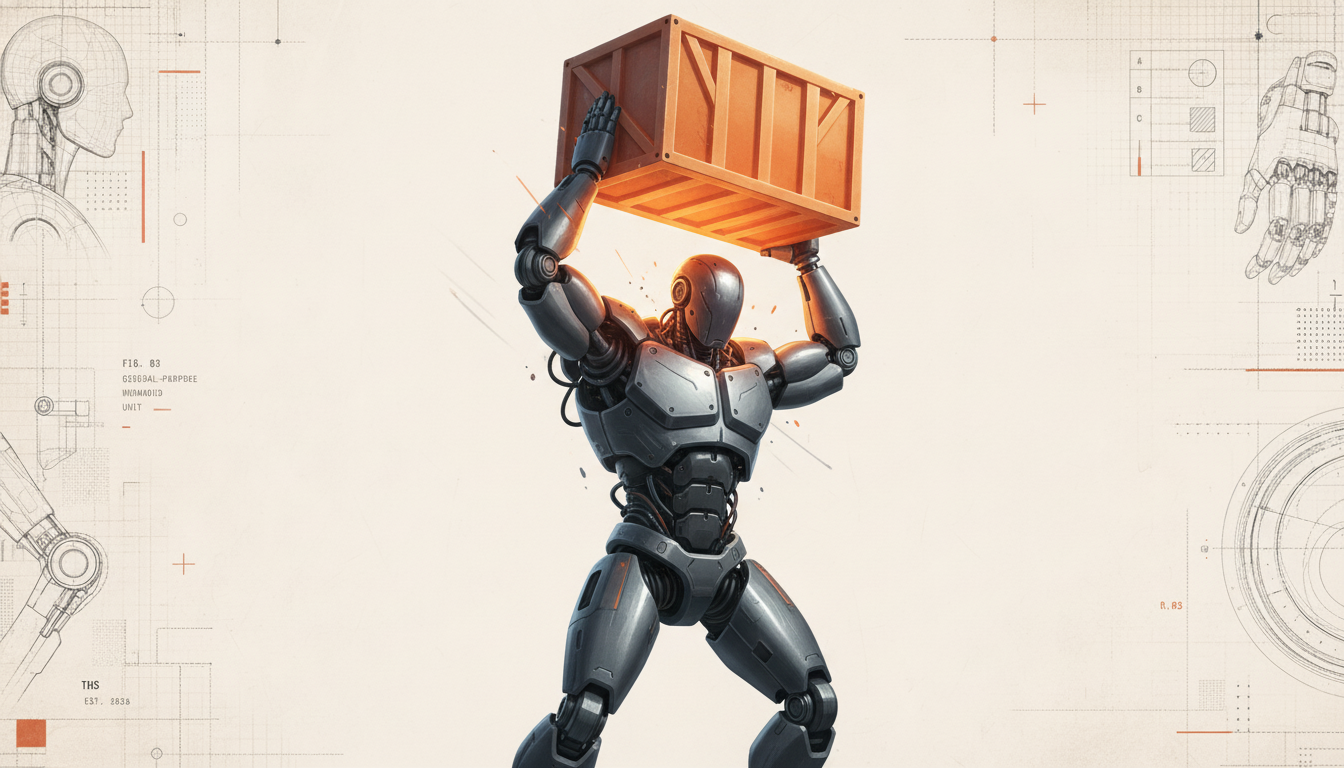
On September 4, Paris-based Wandercraft said it has secured 12 blue-chip customers for Calvin-40, its industrial humanoid, spanning some of the world's largest automotive, logistics, retail, healthcare and defense organizations, and that it is preparing to ramp production to meet demand. The announcement landed days after Bloomberg reported that the company — backed by Renault — is in talks to raise about €100 million ($116 million), advised by Goldman Sachs at a roughly €750 million pre-money valuation, which would be its biggest round yet, just over a year after a $75 million Series D. The robot's distinguishing feature is in its name: Calvin-40 can lift up to 40 kilograms repeatedly without a break, a payload well beyond what most general-purpose humanoids advertise and aimed squarely at heavy material handling rather than stage demos. It runs on NVIDIA's Isaac GR00T N1 foundation model and Jetson computing platform.
Wandercraft is pitching a deliberately different path to a useful robot. 'Humanoid robots will not scale because they are general. They will become general as they scale,' said co-founder and CEO Matthieu Masselin. Rather than chase a do-everything machine, the company aims to establish reliability across defined, commercially valuable task clusters — tires, boxes, parcels, panels and carts today, with picking and sorting in development — then expand outward, building a proprietary data flywheel it controls rather than renting from a single supplier. That discipline comes from an unusual foundation: more than a decade building self-balancing medical exoskeletons, including the Atalante X rehabilitation system now deployed in over 150 rehab centers and the FDA-cleared Eve personal exoskeleton. 'Medical robotics taught us to engineer for environments where failure has real consequences,' Masselin said. Calvin-40 was built in 40 days by reusing that balance-and-control technology.
The most concrete piece of the story is Renault, which is both shareholder and customer. Renault took a minority stake in June 2025, became Wandercraft's first commercial customer for Calvin-40, and already has the robot loading tires onto a line at its Douai plant in France. The roadmap is specific: roughly 10 robots running by the end of 2026, then 350 across Renault's French and Spanish factories by the end of 2027, as part of a push to cut assembly time per vehicle by 30%. Few robotics startups get a captive customer with a production line already waiting — Renault gets robots designed around its own factories, and Wandercraft gets a proving ground that rivals selling into cold markets don't have. But 350 units is a roadmap, not an installed base, and the honest test is whether those robots are actually on Renault's lines by the end of 2027 rather than on a slide.
For an industrial buyer, Wandercraft is the most concrete European alternative to the US and Chinese field, and a useful reminder that spec-sheet payload can matter more than a viral demo: a 40-kilogram lift plus the uptime-and-safety discipline inherited from medical robotics fit exactly the tire-, panel- and parcel-handling jobs procurement teams actually want automated. The cautions are the usual ones. Wandercraft has not published a list price; deployments beyond Renault are early; and '12 customers' spans pilots and commitments rather than a confirmed fleet, with broader delivery a 2027 story. If you are evaluating it, press for what a marketing number can't tell you — a per-unit price, the autonomous success rate and cycle time on your specific task, how many robots one operator supervises, and dated multi-shift output at a named site. As a European-built machine, Calvin-40 does at least sidestep the US import-ban question that shadows Chinese humanoids.
- GlobeNewswire (Wandercraft)September 4, 2026Wandercraft Secures 12 Calvin-40 Customers as It Accelerates Commercial Dominance in Industrial Humanoids →
- Tech Funding NewsSeptember 2, 2026Wandercraft targets €100M funding as Renault prepares to deploy 350 humanoid robots →
- BloombergSeptember 2, 2026Renault-Backed Wandercraft Seeks €100 Million in New Funding →
External links open in a new tab. TheHumanoidStore is not affiliated with any of the publications or companies cited above.