
Robot.com launches R-noid: a wheeled humanoid you can put to work in eight weeks.
July 13, 2026 — Robot.com commercially launches R-noid, a wheeled humanoid sold only as a service, claiming an eight-to-twelve-week path from first site visit to autonomous work.
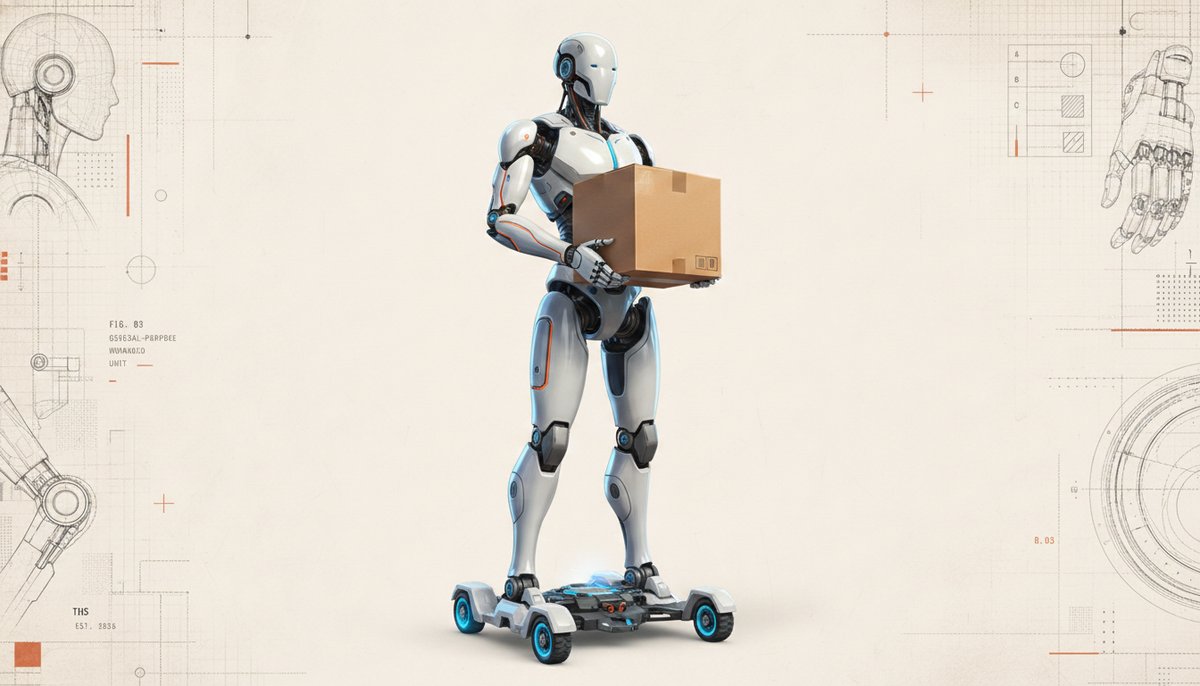
Robot.com — the San Francisco company that spent years running campus-delivery bots as Kiwibot before rebranding in late 2025 — commercially launched a humanoid called R-noid, and its headline claim is about speed rather than spectacle. Sold only under a Robots-as-a-Service model, R-noid can go from a customer's first site visit to autonomous on-site operation in as few as eight to twelve weeks, a deployment pace no rival with paying humanoid customers currently advertises. The launch spans five solution categories — restaurant assistant, packer, picker, folder and host — covering 19 tasks across six verticals: industrial, logistics, healthcare, food service, lodging and experiential retail.
The reason R-noid can promise weeks instead of years is that it sidesteps the two hardest parts of a humanoid deployment. It is not bipedal: a humanoid upper body — dual seven-degree-of-freedom arms and a four-degree-of-freedom torso with reach from the floor to 1.9 meters — sits on a holonomic wheeled base that can move in any direction without turning first. And its navigation runs on FieldAI's Field Foundation Models, a physics-first stack that operates with no GPS and no pre-built map of the building, so there is no weeks-long mapping-and-sensor-tagging phase. Manipulation runs on Physical Intelligence's π0.7 vision-language-action model, all inference happens on NVIDIA Jetson modules aboard the robot, and a partner, Formic, handles the customer-side integration.
The deployment record is still small and the autonomy is partial. As of launch, fewer than 40 R-noid units were in the field across roughly a dozen customers; the clearest live example is a Packer working at Harbor Links Golf Course in Port Washington, New York, with a second Packer moving toward production at an unnamed food manufacturer. By the company's own account, early deployments run at roughly 70 percent autonomy with teleoperation and remote support still in the loop, and some task types need about 50 hours of data collection before the robot operates independently — so eight-to-twelve weeks is the time to first real work, not to full hands-off autonomy on every task. Attempting six verticals at once is also structurally riskier than the single-vertical warehouse focus that Agility and Figure chose; the real test is the tenth site and the thirtieth task type, not the first lighthouse demo.
For a service operator getting hammered by turnover — quick-service restaurants churn staff at more than 130 percent a year, warehouse pickers last about 1.2 years, and roughly two-thirds of hotels report chronic housekeeping gaps — R-noid's pitch is aimed straight at your pain: no hardware to buy, no facility retrofit, a monthly fee, and a robot on the floor in weeks rather than the multi-quarter pilots bipedal platforms have required. The RaaS structure also puts uptime and maintenance risk on the vendor, which is the right side of that trade for a buyer. The catch is that the platform is young and the autonomy is not yet complete, so the questions to put in writing before scaling past a first site are per-task autonomy rates, uptime guarantees, and what happens to the work when the remote operators are busy.
- Robotics & Automation NewsJuly 13, 2026Robot.com launches humanoid 'built for the work that burns people out' →
- Tech TimesJuly 14, 2026Humanoid Robots Now Deploy in Eight Weeks: Kitchens, Warehouses, and Hotels →
External links open in a new tab. TheHumanoidStore is not affiliated with any of the publications or companies cited above.