
NEURA runs its humanoid through an uncut 11-minute laundry chore — and makes a European case for keeping the robot's brain on the machine.
October 20, 2026 — At NVIDIA's GTC conference in Berlin, Germany's NEURA Robotics is putting its 4NE-1 humanoid through an eleven-minute, start-to-finish laundry sequence with no human in the loop, the first public outing of Neuron AI — a multimodal 'brain' the company says runs locally on the robot and keeps a customer's data in-house.
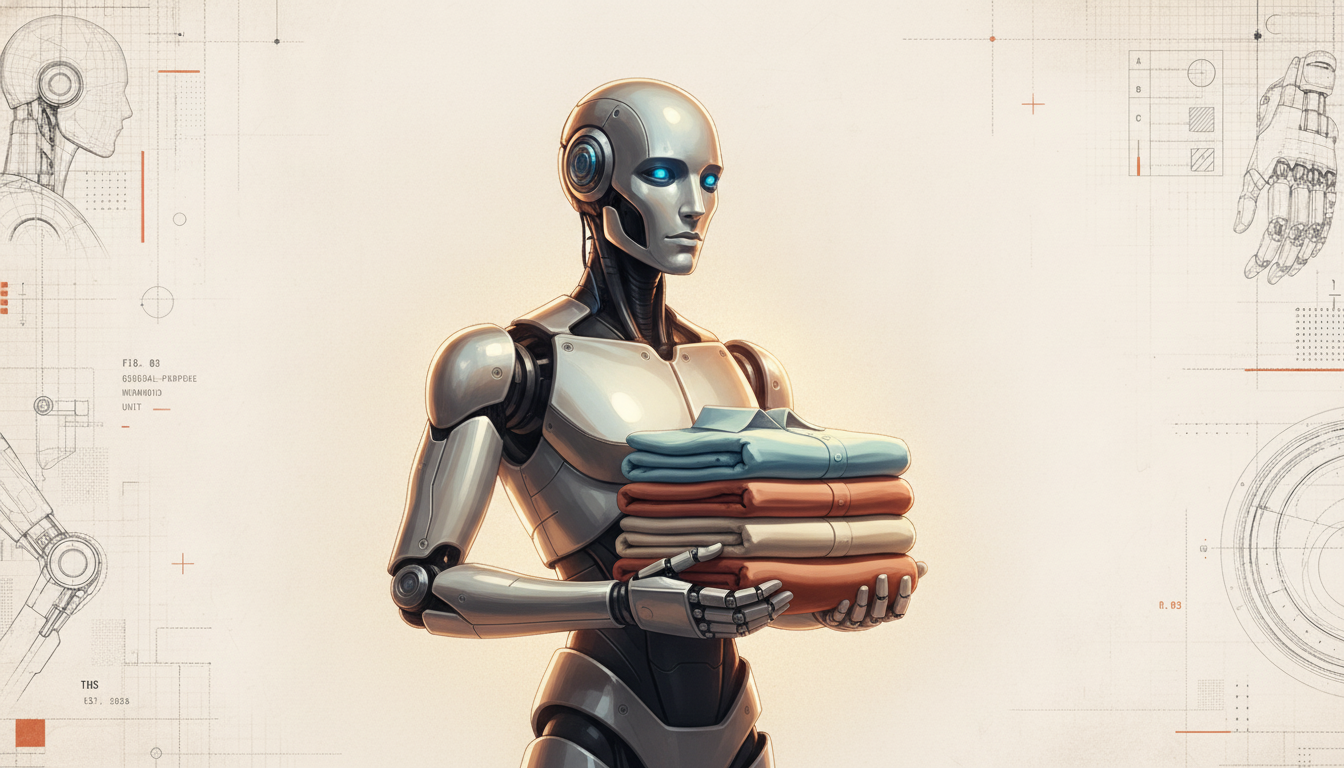
At NVIDIA's GTC conference in Berlin, which runs October 20 to 22, NEURA Robotics is demonstrating its 4NE-1 humanoid — the name is a play on 'For Anyone' — running an eleven-minute laundry-handling sequence autonomously from start to finish: sorting laundry, loading a washing machine, closing and reopening it, unloading it and moving the laundry to a dryer, with no human intervention. It is the first live showing of Neuron AI, the multimodal foundation model the Metzingen company unveiled on October 14. NEURA is careful about what the run proves: it is laundry handling, not a full wash-and-dry cycle, and the hard part is not any single movement but carrying context across the whole sequence — planning each step, perceiving, remembering, and transitioning to the next.
Neuron AI is NEURA's argument for how a robot should think. Its 'Perception-Language-Action' architecture fuses 3D vision with touch and force, audio, the robot's own state and language, and adds a memory function so the machine can track objects and the consequences of its actions even after they leave view — the object permanence that camera-only systems lack. NEURA says it trained the model on three sources, robots working in its 'NEURA Gyms,' simulation-amplified variations, and humans wearing sensor suits, and runs it across five of its robot bodies. The procurement-relevant claim is where the model runs: on the robot itself, with no cloud connection required, so a factory's production data never has to leave the building. That is a deliberate counter to the cloud-hosted model services spreading across the industry, and NEURA — which names Schaeffler and Bosch as data partners and builds everything in Germany — is selling it hard to European manufacturers wary of sending operational data offsite.
Every figure here is NEURA's own. There are no independent benchmarks, no published task-success rates, and no comparisons against rival vision-language-action models; Neuron AI is not a download or an API, but software deployed only on NEURA's robots. An uncut eleven-minute autonomous run is harder to stage than a highlight reel — which is the point of showing it live — but a booth demonstration under the maker's own conditions is still not a shift on a customer's floor. NEURA itself is real but pre-commercial: it raised a record European round backed by Tether, its 4NE-1 is open for reservations with a refundable deposit, and deliveries are targeted for late 2026, which makes the laundry run a capability preview rather than a shipped product.
For a buyer, NEURA reframes the 'whose brain runs the robot' question that has dominated the fall. Where FieldAI is selling a universal brain for anyone's hardware and Physical Intelligence just opened a cloud API to rent its models, NEURA is betting the opposite: one vertically owned model that runs on-device and keeps your data in your building. For regulated or IP-sensitive operations — European factories, healthcare — 'the brain runs locally and your process data never leaves' is a genuine differentiator rather than marketing, cutting both latency and data-governance risk. The caveats to price in are the familiar ones: the numbers are unverified, laundry handling is not a finished chore, and a GTC booth is not your floor. If NEURA is on your shortlist, with reservations open and deliveries targeted for late 2026, ask for task-level success rates under your own conditions, how quickly it actually learns a new job — NEURA's own yardstick is 'Time-to-Skill' — and what running the model locally costs in on-board compute, then read the laundry run as a promising demo, not a delivered capability.
- NEURA RoboticsOctober 14, 2026NEURA Robotics Introduces Neuron AI: The Brain of the Physical World →
- Robotics & Automation NewsOctober 14, 2026Neura Robotics launches multimodal AI model that gives robots perception and memory →
External links open in a new tab. TheHumanoidStore is not affiliated with any of the publications or companies cited above.