
Industrial vs. home: two completely different products.
Same silhouette, different physics. Why the humanoid you buy for your factory won't be the one you buy for your kitchen.
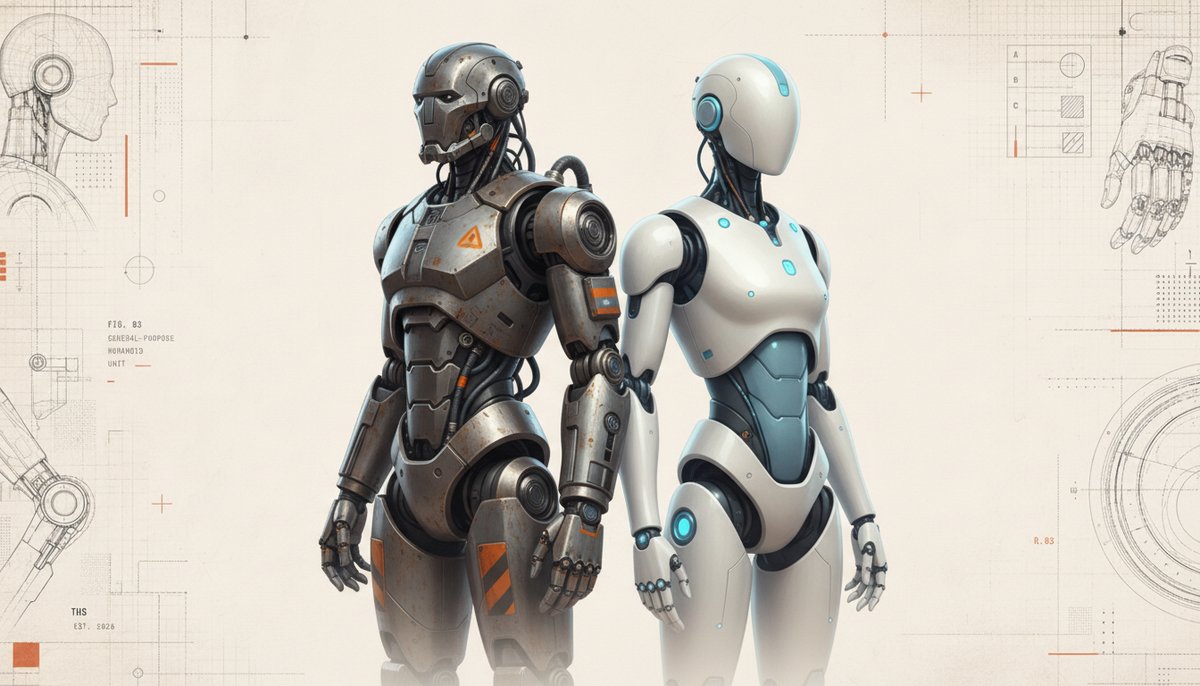
A humanoid is a humanoid, right? Two arms, two legs, a head, a battery. Look closer. The industrial and home segments are diverging fast, and the units on our shelves reflect it.
Industrial humanoids optimize for payload, uptime, and repeatability. That means heavy actuators, hot-swappable batteries, and safety architectures built for cage-free operation next to certified workers. Figure, Apptronik, and Agility all target this envelope. So does UBTECH's Walker S1, currently working night shifts at BYD.
Home humanoids optimize for a completely different set of properties: acoustic quietness, soft contact, conversational latency, and a form factor that doesn't terrify children or trip over pets. 1X's NEO Gamma is the clearest expression of this — a knitted polymer exterior wrapped around whisper-quiet tendon actuation.
The security segment sits in between. Boston Dynamics' Atlas Sentinel and Apptronik's Apollo Inspect trade payload for sensor mass and IP-rated enclosures.
Which department is right for you? Match the environment first. A robot built to fold laundry will never move totes at 3 m/s. A robot built to move totes will never be quiet enough for your baby to nap through.