
Honda quietly returns to humanoids — betting the hard part is the hand, not the walk.
August 13, 2026 — ASIMO's maker resurfaced in humanoid coverage this week with an 'Avatar' robot and a multi-fingered hand it says can thread a needle and lift five kilograms — a dexterity-and-teleoperation bet that sidesteps the autonomous-worker race.
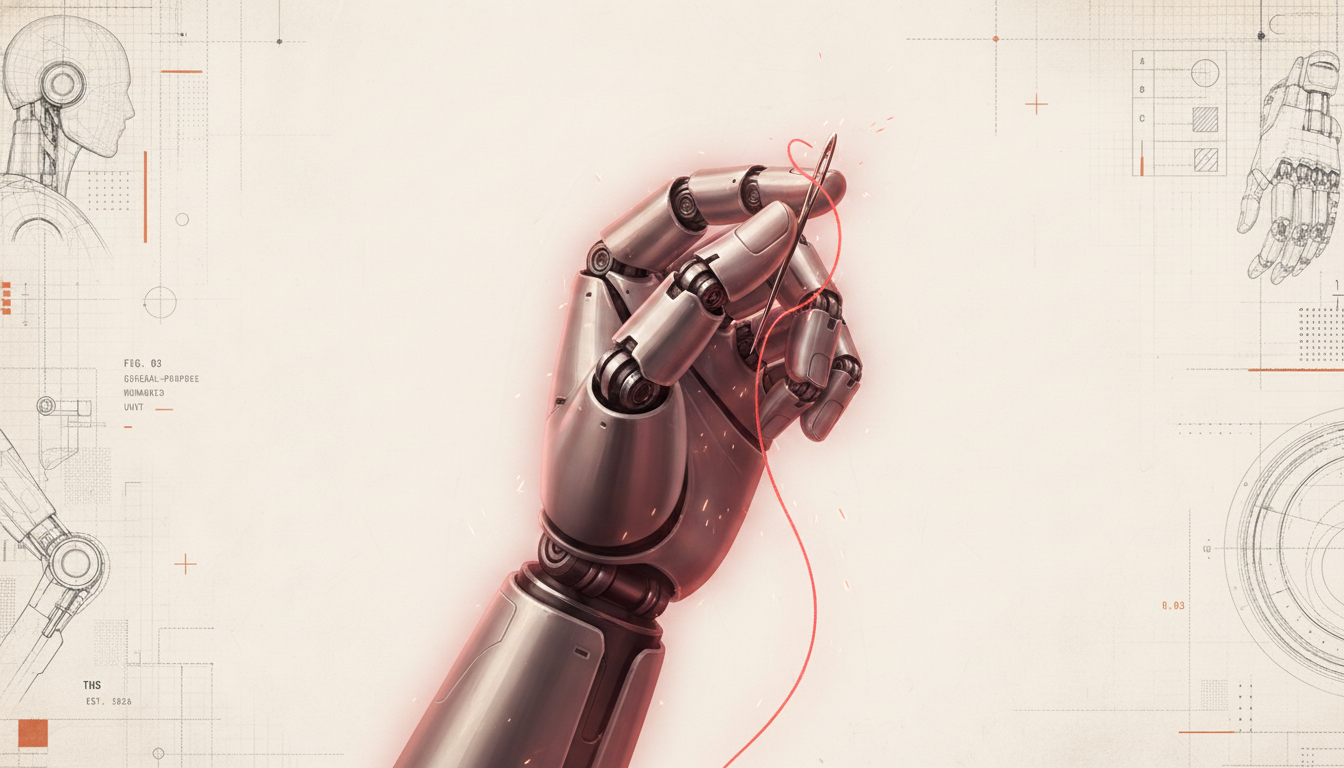
Honda, the company whose ASIMO was for two decades the world's most recognizable humanoid, is back in the conversation on its own terms. In coverage that resurfaced this week, including an August 13 feature from Robotics & Automation News, Honda detailed its Avatar Robot and a new human-scale multi-fingered hand it demonstrated at the Humanoids Summit 2026 in Tokyo in May. It is less a comeback than a continuation: Honda began bipedal-robot research in 1986, its P2 robot earned an IEEE Milestone in April 2026, and the company says engineers who built ASIMO — retired in 2022 — carried that expertise into the Avatar program. Crucially, the Avatar Robot is not pitched as an autonomous factory worker. It is designed as a physical extension of a remote human operator, for hazardous sites, remote maintenance, disaster response and eventually space.
The headline hardware is the hand, and the figures Honda cites are aimed squarely at the tasks that break most humanoids. Honda says the hand can thread a needle, use scissors, tighten screws and still handle heavy objects. It packs 16 actuated joints with joint speeds up to 180 degrees per second, fingertips that can each exert as much as 50 newtons of continuous force, six-axis force sensors in the fingertips and 288 tactile-sensing channels across the fingers and palm. The company says it ran the mechanism through more than 450,000 durability cycles, including 24,000 cycles lifting a 5-kilogram weight, and — unlike ASIMO's torso-mounted hydraulics — drives the fingers with cables from motors in the forearm, the way human tendons work. Honda's claim is that the hand has reached a level where it can 'work like a human.' Those are Honda's own numbers on a research platform, not an independently benchmarked product.
The strategy is the real story. Walking, once the field's grand challenge, is now nearly table stakes; the unsolved problem is a hand reliable enough to do useful work for hours. Rather than chase a fully autonomous general-purpose humanoid, Honda is breaking the problem into pieces that can be useful on their own — a capable hand, and a teleoperation system in which the human makes the high-level decisions while the robot handles low-level execution. That human-in-the-loop framing is suddenly everywhere: it echoes Avatar Robotics' seed round last week and 1X's teleoperated 'Expert Mode' for its home robot, and the honest admission underneath all of them is that hands-off autonomy is not here yet. Honda, notably, has announced no product, customer, price, production target or deployment date, and points to practical use only in the 2030s.
For a buyer, Honda is a signal rather than a vendor — there is nothing to purchase. But it sharpens two questions worth carrying into any humanoid evaluation. First, judge robots by their hands: ask not only about degrees of freedom and fingertip force but about cycle life, because a hand that degrades after a few hundred thousand grips cannot hold down a real shift, and durability is exactly what Honda is advertising. Second, treat teleoperation as the honest near-term answer rather than a red flag — if a vendor promises full autonomy today, ask precisely what a remote operator is doing, and how often. The development most likely to matter for procurement is not another full Honda humanoid; it is whether Honda's hand becomes a component other makers can buy, which would say more about where the money is than any walking demo.
- Robotics & Automation NewsAugust 13, 2026Honda's new 'Avatar' humanoid robot suggests the spirit of ASIMO is very much alive →
- HondaAugust 13, 2026Honda Avatar Robot →
- eWeekAugust 12, 2026Honda's Robotics Ambitions Are Taking Shape After ASIMO →
External links open in a new tab. TheHumanoidStore is not affiliated with any of the publications or companies cited above.