
Robots beat Usain Bolt in Beijing — but the machines that won the real work were already on a factory floor.
August 26, 2026 — At the second World Humanoid Robot Games, two robots broke Usain Bolt's 100-meter record, yet the more telling result was AgiBot topping the medal table with mass-produced robots — the same models already deployed in factories — sweeping the dexterity and real-world work events.
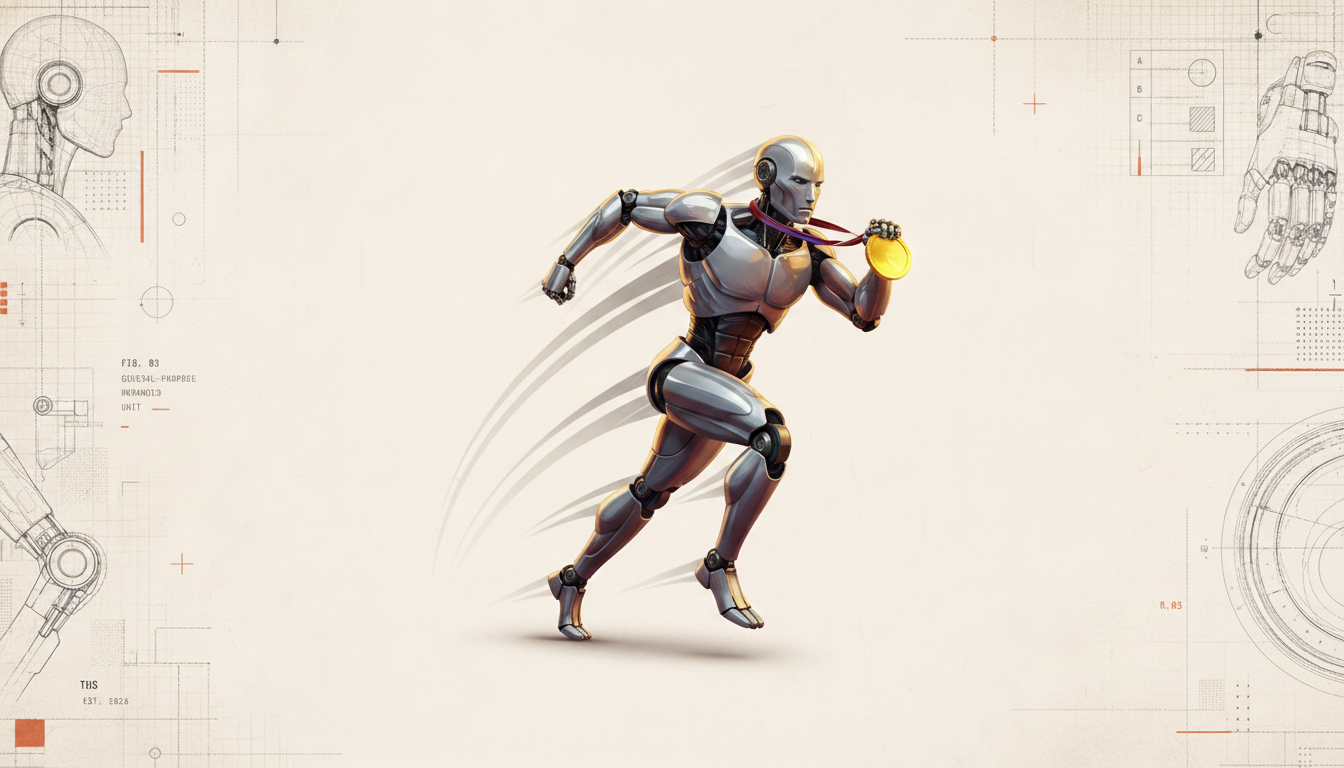
The second World Humanoid Robot Games, held August 22-26 at Beijing's National Speed Skating Oval, delivered the viral moment its organizers wanted: two robots ran the 100 meters faster than Usain Bolt's 9.58-second human world record, with the Beijing Humanoid Robot Innovation Center's Tiangong Ultra clocking 9.39 seconds. A humanoid also cleared a 2.88-meter standing high jump, well past the 2.45-meter human mark, and ran 400 meters in 39.7 seconds, inside Wayde van Niekerk's world record. It was a startling jump from 2025, when the winning 100-meter time was over 20 seconds — though the caveats were visible too: braking was a problem, with machines slamming into a crash mat placed several meters past the finish line. The Games drew 2,056 robots from 666 teams across 16 countries — the overwhelming majority Chinese — and split 51 events between 30 sports contests and 21 scenario-based tasks, more than 40% of which required full autonomy.
For a buyer, the useful part of the Games is not the sprint times but the scenario events, which read as an honest map of what humanoids can and cannot yet do on their own. Alongside the track, robots competed at electric-vehicle charging, restaurant and hotel service, emergency response, industrial assembly, material loading, and a cable-connection challenge that tests vision, mechanical alignment and force control. As Lumos Robotics chief executive Yu Chao put it, 'only when it can work in those end scenarios does it have real value — simply running and jumping does not improve efficiency.' The gap between the two categories is the story: flat-ground sprinting is now solved well enough to be run fully autonomously, while the fiddly, deformable, error-prone work of a real job — a cable at the wrong angle, an object just out of reach, a shifting package — is exactly where the machines still stumble, and where a human is still often at the controls.
And the machines that won that work were not bespoke racers. AgiBot, which earlier this year became China's top humanoid shipper, made its Games debut and finished first on both the gold and overall medal tables, with 46 medals including 18 golds spanning dexterous manipulation, scenario tasks and motion control. Its OmniHand reached the finals in all eight dexterous-hand events and took seven golds — including bean-picking with tweezers and powder-weighing — and its robots won five golds in real-world scenarios such as hotel service, library operations and emergency response. Crucially, AgiBot says it fielded its standard, mass-produced lineup — OmniHand, G2, A3 and X2 — with no competition-specific modifications, and that the G2 model used in the scenario events is already working in factories run by Longcheer and SAIC. That is the buyer-relevant headline hiding under the Bolt comparison: the same hardware a company runs on a real production line also swept the manipulation and service tasks.
So the Games cut against the reflex to equate humanoid progress with athletic spectacle. For a procurement team, a robot that can win a cable-plug or a bean-pick on the very hardware it runs in a plant is worth far more than one built to set a 100-meter record, and AgiBot's medal sweep with deployed machines is a genuine signal — even if a controlled arena is still not a paying customer's floor, as one exhibitor noted: the real contest is whether, after the product is sold, it can solve users' problems. Two familiar caveats still apply. The autonomy on display is uneven — many dexterity and terrain tasks still allow teleoperation, and even the autonomous sprinters could not brake reliably — so a medal is a demonstration, not an audited shift. And nearly everything on the floor is Chinese-made and now blocked from new US sale by the July FCC ban, so an American buyer should read these results as a capability benchmark, not a shopping list. Watch what wins the work events on deployed hardware; discount the times on the track.
- Reuters (via BusinessWorld)August 23, 2026Robots can outrun humans, but can they plug in a cable? →
- Robotics & Automation NewsAugust 27, 2026Agibot wins 46 medals to top World Humanoid Robot Games on debut →
- WikipediaAugust 26, 2026World Humanoid Robot Games (2026) →
External links open in a new tab. TheHumanoidStore is not affiliated with any of the publications or companies cited above.