
Generative Bionics unveils Gene.01: Europe's answer is a humanoid that feels you coming.
July 23, 2026 — Italian IIT spin-out Generative Bionics gave its Gene.01 humanoid a U.S. debut, betting that full-body electronic skin and a 'sovereign' European supply chain beat raw horsepower on the factory floor.
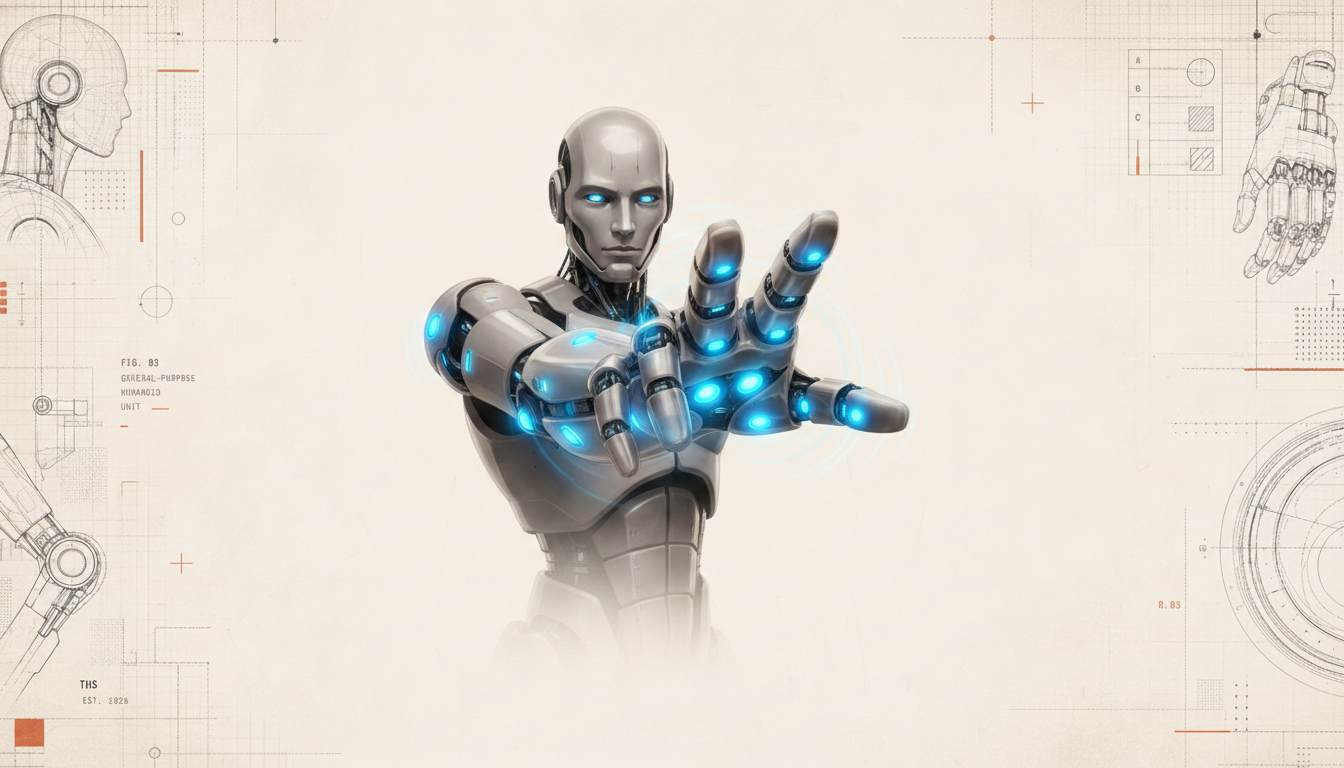
Generative Bionics, a Genoa-based deep-tech company spun out of the Italian Institute of Technology in 2024, gave its Gene.01 humanoid a U.S. debut this week at AMD's Advancing AI 2026 conference, and its pitch is the opposite of a spec-sheet arms race. The company says it built the fully functional, sensorized robot in six months, and the defining feature is not payload or speed but touch: Gene.01 is wrapped in a full-body distributed tactile skin that senses touch, force, temperature and proximity across its whole surface, letting it register a person entering its space and start adjusting before any contact happens. CEO Daniele Pucci — who led the humanoid programs the robot descends from at IIT — argues that 'physical AI must be human-aware, physics-native, and industrial from Day 1,' and frames Gene.01 not as one product but as a base platform to be customized per customer at the AI, exterior-design and end-effector levels.
The engineering thesis is that safety and dexterity come from feeling, not just seeing. Most human-robot collaboration in 2026 still leans on external cameras and laser-defined safety zones; Gene.01's skin senses in every direction with no line-of-sight, so the robot can slow or yield the instant someone gets close. That same sensing lets a worker teach a task by physically guiding the robot's arm and demonstrating not only the motion but how much force to use — the company argues this solves problems video-only learning cannot, like gripping an object firmly enough not to drop it yet gently enough not to crush it. The approach is grounded in peer-reviewed work: a paper on the predecessor ergoCub robot, published in Nature Machine Intelligence in July, describes co-optimizing a humanoid's body and its control policy around human ergonomics. Generative Bionics is also open-sourcing Gene.01's digital twin through the channels developers already use — PyPI, conda-forge and the official ROS build farm — so a single install pulls the robot's model into existing simulation pipelines.
The money and the strategy both read European. Generative Bionics raised €70 million (about $81 million) in a seed round led by Italy's state-backed CDP Venture Capital, with AMD Ventures, Duferco, Eni Next, RoboIT and Tether taking part, and it has recruited a former Ferrari plant manager to run production. It is explicitly building toward what it calls a 'sovereign' physical-AI ecosystem — European final assembly, calibration and safety testing, anchored by an EU-protected actuation stack co-developed with Germany's Synapticon. Its first real job is narrow and telling: a welding humanoid for the shipyards of Fincantieri, one of the world's largest shipbuilders. The caveats are equally clear-eyed. This is a freshly unveiled platform, not a shipping product — commercial deployment is still ahead, there is no public price, and 'built in six months' is a claim about a demonstrator, not a proven duty cycle. The tactile-skin safety story is genuinely differentiated, but it has not yet been validated by a third party on a live line.
For a European industrial buyer, Gene.01 earns a slot on the watch list for reasons that have little to do with the demo reel. The continent's shortlist is filling out fast — the U.K.'s Humanoid, Germany's Neura and Agile Robots, and now an IIT spin-out with two decades of humanoid research behind it — and Generative Bionics is leaning into the two things European procurement increasingly has to price in: a trusted, in-region supply chain and a safety architecture designed for people sharing the floor rather than being fenced off from it. That matters more this week than last, because Washington's new ban on Chinese robots is pushing Beijing's makers toward Europe just as home-grown options mature. The questions to put to Generative Bionics before it earns a pilot are the ones a tactile-skin pitch does not answer on its own: sustained uptime, autonomous task success without teleoperation, a firm price, and independent certification against the collaborative-robot safety standards European plants already run on.
- The Robot ReportJuly 21, 2026Generative Bionics unveils humanoid robot with full-body tactile sensing →
- Generative Bionics / PR NewswireJuly 20, 2026Generative Bionics Introduces Gene.01, a Fully Functional Smart-Skin Humanoid Robot Platform →
- Tech TimesJuly 24, 2026Italian Startup Debuts Gene.01 Humanoid With Skin That Senses Humans Before Contact →
External links open in a new tab. TheHumanoidStore is not affiliated with any of the publications or companies cited above.