
Figure melts its F.02 fleet in a Finnish furnace — a Terminator-style tell that the hardware is iterating faster than it ships.
September 30, 2026 — Figure retired its Figure 02 fleet by training the robots to leap autonomously into a 75-ton electric-arc furnace in Finland, protecting its proprietary hardware and clearing engineers to launch its next-generation F.04 — a vivid marker of how fast the company is cycling platforms, and a reminder you still can't buy one.
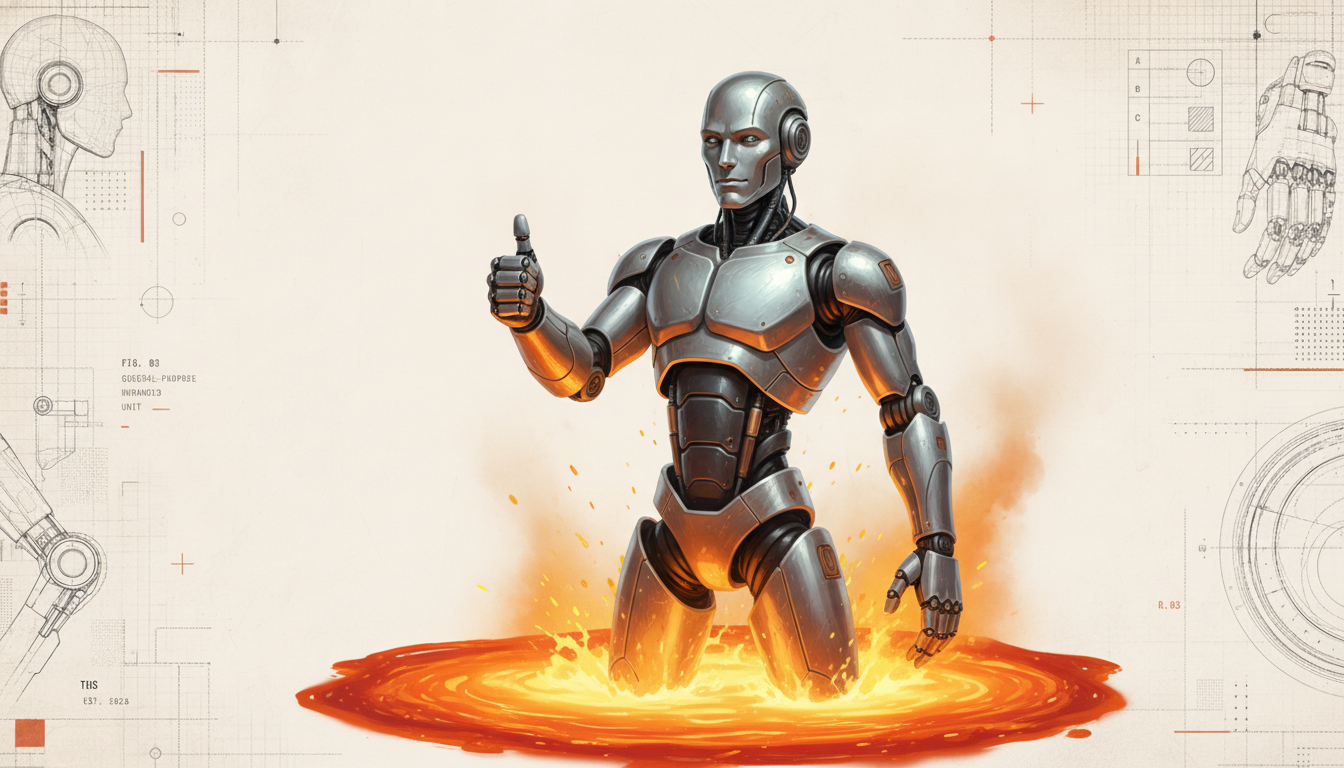
On September 30, Figure published a short film called 'F.02 Decommission' documenting how it retired most of its Figure 02 fleet: by training the robots to walk off a platform and leap, autonomously, into a 75-ton electric-arc furnace at a foundry in Imatra, Finland. The company was blunt about why. 'As our F.03 fleet grows, maintaining the F.02 fleet no longer makes sense,' it wrote — and disassembling each robot by hand was not an option because the machines are full of custom-built actuators and other intellectual property. In Figure's words, taking them apart 'would take our technical staff so much time that it would delay the launch of F.04.' So it chose a disposal method that destroyed the hardware while protecting what is inside it.
The execution was equal parts engineering and marketing. No foundry in the US or Mexico would let a robot packed with lithium-ion batteries jump into its equipment; Figure says it even asked former MythBusters staff to help find a site before Imatra agreed. The idea to melt them came from Arnold Schwarzenegger, who told the company to 'melt them' and then appeared in the film — a direct homage to the molten-steel finale of Terminator 2. Engineers trained the robots at Figure's San Jose campus using airbags and second-floor jumps, with stunt-artist motion as reference, then trained a new AI model in simulation so the machines could hit a bucket of molten steel at a foundry they had never visited. The team had 24 hours and six melts, each with a roughly 20-minute window before the steel crusted over; Figure says the robots ran their AI policies 'seamlessly' even as the heat and electromagnetic fields disabled nearby cameras. The recovered metal bars were shipped back to the US to be machined into a limited run of commemorative artifacts, priced at $500 and $1,900.
F.02 is not a trivial robot to retire. It was the generation behind Figure's first deployment at BMW's Spartanburg plant — where, across roughly 11 months, the units helped build more than 30,000 X3s and handled over 90,000 parts — as well as the birth of Figure's Helix vision-language-action model and the company's first household-chore and logistics work. The now-dominant F.03, introduced in October 2025, carries a redesigned sensor and hand suite built for Helix plus softer materials and wireless charging aimed at homes, and a fourth platform, F.04, is already close behind. The software is moving too: Figure recently reported that its Helix 2.5 model completed tidying, towel-folding and bed-making zero-shot across 30 unfamiliar Bay Area homes at a company-reported 56% success rate, up from 9% without its crowdsourced pretraining — promising, but well short of product-ready home autonomy.
For a buyer, the furnace is a stunt, but it carries two signals worth taking seriously. The first is cadence: Figure is cycling hardware generations so quickly that its proven BMW workhorse is already scrap and a fourth platform is imminent. Capability is improving fast, but anything bought today would be a generation behind within a year — one reason Figure still sells to no outside customer, lists no public price, and runs its fleet internally and for data collection. The second is where the value sits: a company that would rather melt its robots than let anyone examine them is telling you the moat is the custom hardware — the actuators and mechanics — as much as the AI. Procurement teams tracking Figure should watch for the moment F.03 and F.04 leave the pilot-and-data phase for dated, paid outside deployments, and should treat the fast generational churn as a reason to favor leasing or support contracts over owning a fleet that obsoletes this quickly.
- FigureSeptember 30, 2026F.02 Decommission →
- Interesting EngineeringSeptember 30, 2026Humanoid robot fleet decommissioned in wild Terminator-style leap into molten steel →
- TAO.MediaSeptember 30, 2026Figure Decommissions F.02 Fleet by Melting Robots in Finland With Arnold Schwarzenegger →
External links open in a new tab. TheHumanoidStore is not affiliated with any of the publications or companies cited above.