
Feather launches a $29,990 'Android of robotics' — a two-armed robot you buy, then pick your own AI brain.
September 24, 2026 — California startup Feather Robotics came out of stealth with a $29,990 wheeled, two-armed robot that ships now and lets buyers choose their own compute and AI model — $7.6 million raised, more than $1 million in revenue, and a bet that cheap, open hardware beats a sealed do-everything machine.
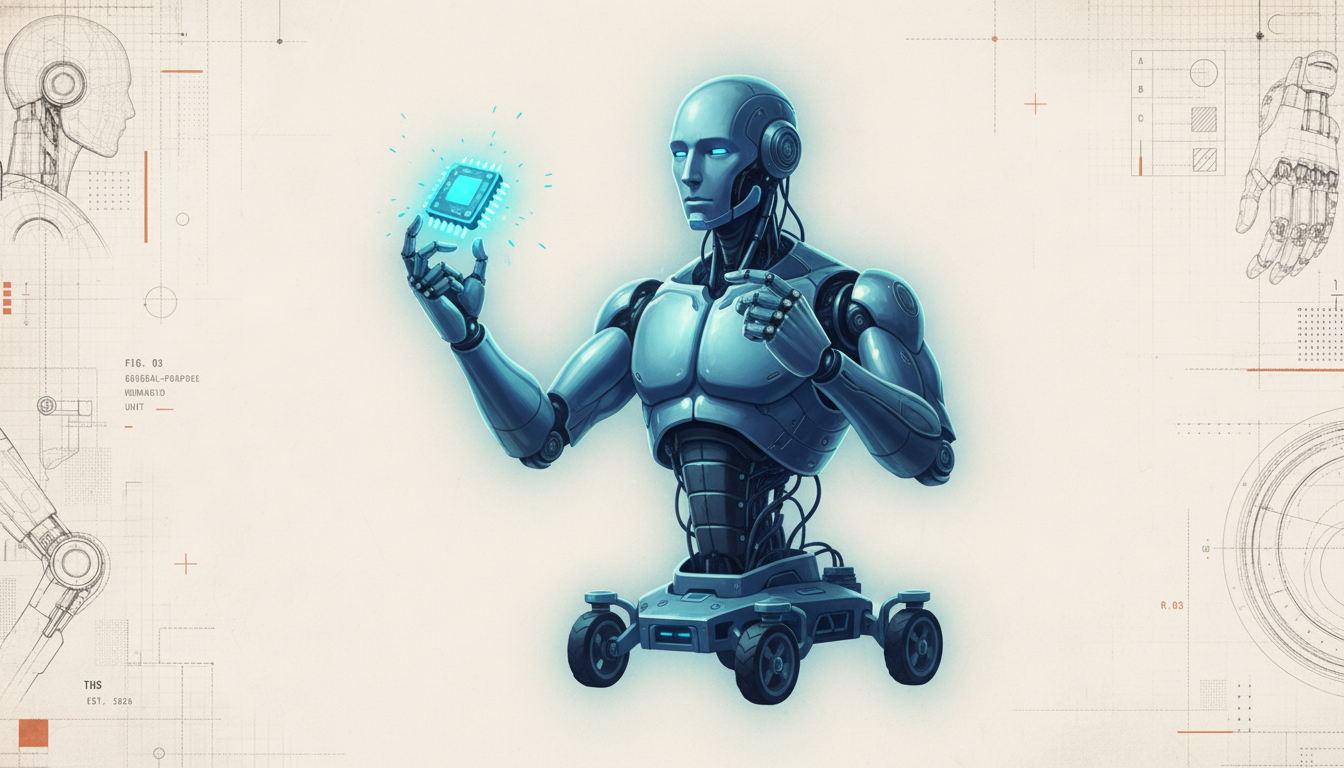
On September 24, a California startup called Feather Robotics came out of stealth with a bimanual mobile manipulator that costs $29,990 — about half the price of Unitree's H2 EDU — and, unusually for a pre-seed hardware company, more than $1 million in revenue already booked. Feather raised a $7.6 million pre-seed round led by Gradient Ventures, with BuilderVC, Geometry, SEED Innovations and Virgo VC joining, and says its robots have been field-testing for about a year, working as cooks in restaurants and cleaning up science labs. The founders carry real pedigree: CEO Hoa Mai previously sold a humanoid startup to 1X, and co-founder Parsa Bakhtiari is a former Tesla Model 3 engineer who at one point reported directly to Elon Musk.
Feather is not a biped. It pairs two seven-degree-of-freedom arms with a one-meter reach on a torso that rises and drops 600 millimeters — collapsing from about 1.2 meters to about 1.8 meters, so it can pick off the floor or reach a high shelf — mounted to a holonomic wheeled base that moves in any direction at up to 1.3 meters per second. It has 23 degrees of freedom in total, weighs 105 kilograms, and runs on dual hot-swappable 48-volt batteries good for roughly 10 hours. The hands are swappable (six-DoF hands or parallel-jaw grippers), and so, in the key twist, is the brain: buyers choose their Nvidia Jetson compute, from Nano to Thor, and run whatever robot-AI model they like — from Nvidia, Skild, Physical Intelligence or anyone else. Feather builds the body and leaves the intelligence layer to the customer, pitching itself as 'the Android of robotics' against sealed, vertically integrated machines. 'You can't buy a Tesla robot today and develop on top of it,' Mai told TechCrunch.
The launch lands in a field that is cheapening fast. Feather joins a wave of low-cost machines — Nori A3 ($1,688, assembled in San Francisco), PrimeBOT home robots (about $2,750 in China) and Unitree's R1 ($4,900) — while the capability frontier still runs six figures, with Faraday Future having just launched robots from $9,990 to $137,900. Goldman Sachs estimates humanoid manufacturing costs fell 40% in a single year as components commoditize. And the FCC's July ban on new Chinese humanoid imports hands a US-built, developer-friendly platform an opening; Gradient general partner Darian Shirazi calls Feather the only US startup building a modular humanoid platform, and frames the economics against a human laborer who costs $50,000 to $60,000 a year plus training and HR.
For a buyer, Feather is one of the few humanoids you can actually purchase today, at roughly the price of a new car, and its open design cuts two genuine risks: you are not locked to one vendor's AI, and you can upgrade the compute as models improve. The trade-offs are just as real. This is a wheeled two-armed manipulator, not a legged general-purpose robot; its useful payload is a few kilograms per arm; and the intelligence that turns it into a worker is yours to source and integrate, which assumes in-house robotics or ML talent rather than an out-of-the-box solution. It is also a pre-seed startup, so weigh support and spare-parts longevity before you standardize a line around it. But the direction is unmistakable: in the same week IDC pegged the average humanoid at about $29,600 with prices in free-fall, a buyable, developer-first machine at exactly that price is a sign the 'where can I actually buy a working humanoid' question finally has more than a couple of honest answers.
- TechCrunchSeptember 24, 2026Meet Feather, the startup building the 'Android of robotics' for developers →
- ForbesSeptember 25, 2026Feather Launches $29,990 Humanoid Robot. Small Teams Are Rewriting The Economics Of Humanoids →
- Feather RoboticsSeptember 24, 2026Technology — Full specifications →
External links open in a new tab. TheHumanoidStore is not affiliated with any of the publications or companies cited above.